
The goldfinch, a small yet graceful bird, holds a unique place in European culture and mythology. According to Greek legend, Athena transformed a mortal named Acalante into this lively bird.
Throughout history, it has come to symbolize the soul’s journey beyond death, a belief rooted in ancient pagan culture and later adopted by Christian traditions.
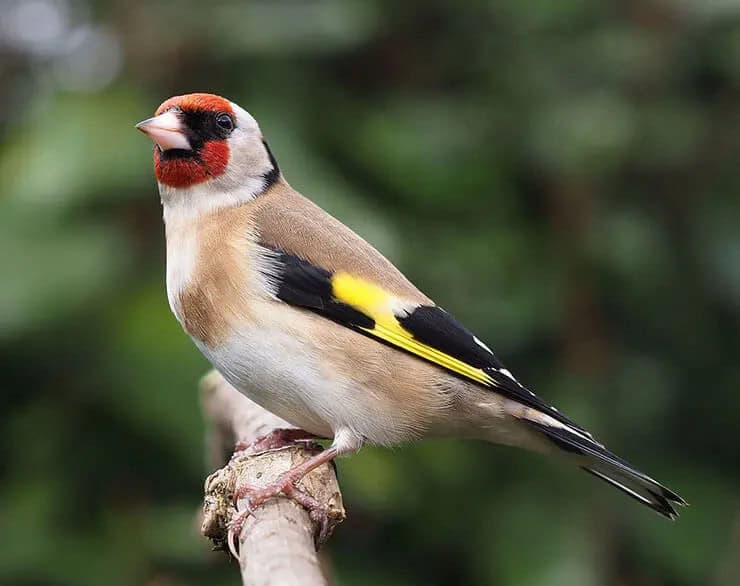
The distinct red mark on the goldfinch’s face is even tied to Christian iconography, as legend says the bird was injured while removing thorns from Christ’s crown.
This touching story inspired the Renaissance artist Raphael to depict the goldfinch in his “Madonna del Cardellino” (1505-1506), where Saint John the Baptist presents a goldfinch to Jesus, symbolizing his future sacrifice.

Everything About the Goldfinch
Overview
One of the most recognizable birds, even to those unfamiliar with birdwatching, the goldfinch belongs to the Fringillidae family, alongside the common canary.
Native to regions across Europe, Asia, North Africa, Iran, and the Canary Islands, this bird is celebrated for its distinctive warbling song.
Sadly, its enchanting voice has also made it a target for capture, and throughout history, goldfinches have been taken from their natural habitat to be kept in captivity.

Quick Facts
- Scientific Name: Carduelis carduelis
- Weight: 12 – 18 g
- Wingspan: 21 – 25 cm
- Lifespan: Typically 8-10 years, with some reaching up to 12 years
- Diet: Primarily seeds, especially those of thistles and sunflowers, as well as agrimony, chicory, and dandelion.
- Habitat: Prefers areas with flowered meadows, open woods, orchards, parks, and gardens.
- Threats: Common predators include hooded crows that prey on eggs. Strong winds can also dislodge nests, which are often built on outer branches.
- Due to its beauty and its ability to breed with other finch species, the goldfinch is a popular cage bird across Europe. This demand has led to the illegal capture and raising of goldfinches in captivity. Additionally, the loss of forested areas poses a risk to goldfinch populations in rural settings.
Physical Appearance
The goldfinch stands out with its colorful plumage and petite size, measuring just over 10 cm in length and weighing around 12 grams. With a red face, white cheeks, black head, beige body, and striking yellow and black wings, it is visually captivating.
The female’s colors may be slightly less vibrant than the male’s, but both sexes are admired for their lively warbling.
Geographic Range and Subspecies
Only one goldfinch species, Carduelis carduelis, exists, but it includes various subspecies found from northern Europe to Siberia and North Africa. Northern types, such as the Siberian goldfinch (Carduelis carduelis major), tend to be larger than their southern relatives.
Notably, the Himalayan goldfinch (Carduelis carduelis caniceps) lacks the typical black cap, replaced instead by a greyish tone that spreads across its back.
The species was introduced to Australia in 1860, initially in urban areas, and has since adapted to rural landscapes, reaching southeastern Australia, Tasmania, and New Zealand.
Diet and Feeding Behavior
Goldfinches forage mainly on seeds from weeds and grasses, often gathering in small flocks. During the breeding season, they also consume small invertebrates, vital for their growing chicks. Their strong beaks allow them to break seeds, particularly favoring thistles, amaranth, dandelions, and chickweed.
Breeding Habits
Goldfinch pairs typically stay together for the breeding season, defending their nesting territory with the male’s melodic song. The nest is a compact cup, woven with grass, moss, and soft materials like animal hair and aromatic flowers, usually built high in trees or shrubs.
The breeding season, from October to February, often produces two broods of 4-5 chicks each. The male feeds the female during incubation, and both parents contribute to feeding the chicks until they are ready to fledge.
Conservation Status
The International Union for Conservation of Nature (IUCN) classified the goldfinch as of “least concern” in 2018. In Europe, where about 55% of their range lies, populations were stable between 1970 and 1990 and saw slight growth from 1990 to 2000.
However, recent years have seen some declines in specific areas, such as Turkey. The total European breeding population was estimated at 27.8-42.7 million pairs in 2015, equating to roughly 101-155 million adult goldfinches worldwide.
Read More Birds